
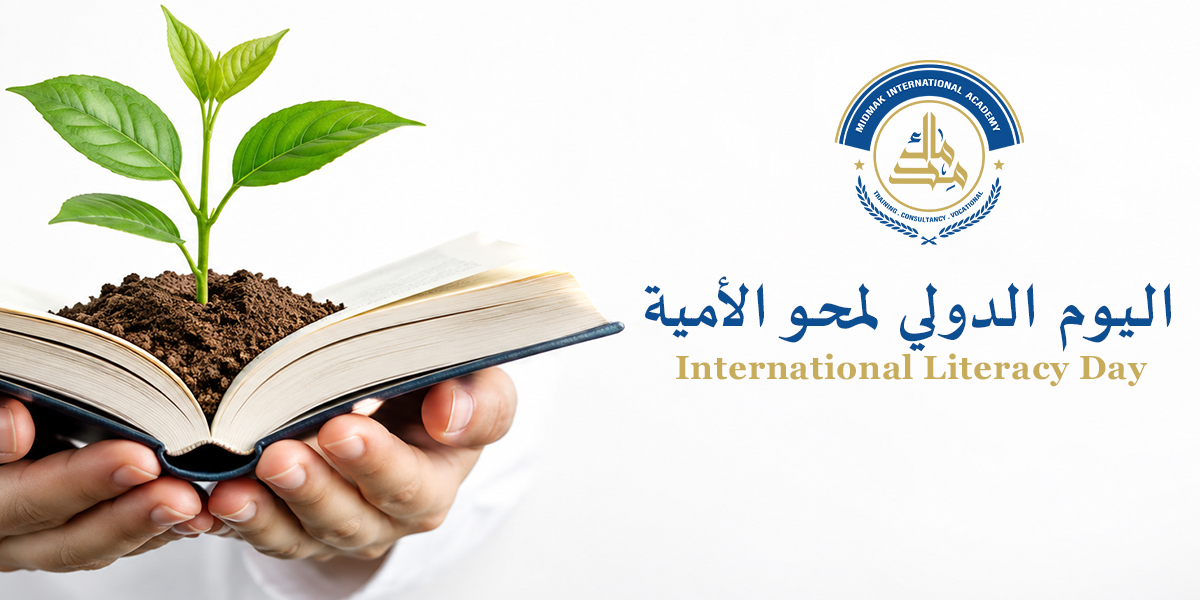
International Literacy Day
From the Right to Knowledge to the Power to Shape the Future
By Dr. Dima Aziz Barakat
President of Midmak International Academy
Every year, on September 8, International Literacy Day invites us to reflect on an issue that goes far beyond the ability to read and write. At its heart lies one of the most profound questions of human development:
How can we empower individuals with the knowledge, skills, and capacity to learn, participate meaningfully, and shape their own futures?
Literacy is not merely an educational goal measured by the number of people who have mastered reading and writing. It is a fundamental gateway to human development, strengthening an individual’s ability to understand, participate, make informed decisions, and contribute meaningfully to society.
For this reason, International Literacy Day is an opportunity to reaffirm a fundamental truth:
Knowledge is a right. Learning is a pathway to empowerment. And educated, capable individuals are among the essential foundations of sustainable development.
The world has made significant progress in addressing illiteracy in its traditional sense. Yet the rapid transformations taking place in knowledge, technology, and the world of work require us to reconsider the very meaning of literacy and to ask:
Are reading and writing skills alone sufficient to enable individuals to engage effectively with an increasingly complex and rapidly changing world?
In the twenty-first century, the question is no longer simply:
Can a person read and write?
It has become broader and more profound:
Can they understand what they read?
Can they verify the accuracy and credibility of what they know?
Can they engage with technology consciously, critically, and responsibly?
Do they have the ability to acquire new skills as the demands of life and work continue to evolve?
This is where the next chapter in the fight against illiteracy begins—a chapter that moves beyond teaching the basic tools of knowledge and toward empowering individuals to apply knowledge and create meaningful impact through it.
Literacy Beyond Reading and Writing
There is no doubt that reading, writing, and numeracy remain the essential foundations of learning. Yet today, these foundations form part of a broader set of competencies that individuals need in order to participate fully and effectively in society.
Contemporary individuals live in an environment where information flows at an unprecedented pace and encounter multiple and diverse sources of knowledge every day. In such an environment, the challenge does not always lie in the scarcity of information, but rather in the ability to access it, understand it, analyze it, assess its credibility, and ultimately use it in a conscious and responsible manner.
Contemporary literacy therefore involves developing an integrated range of capabilities, including digital and information literacy, critical thinking, effective communication, problem-solving, and the capacity for continuous learning.
Literacy is no longer simply a project aimed at addressing a deficiency in a basic skill.
It has become a project of building individuals who are capable of understanding a changing world, engaging with it intelligently, and contributing to shaping it.
From Literacy to Lifelong Learning
One of the most important shifts that must become firmly rooted in contemporary educational and training thought is the recognition that learning is not confined to a particular stage of life; it is a lifelong journey.
Knowledge evolves, technology advances, professions change, and the skills required by the labor market continue to transform. Consequently, obtaining a qualification at a particular stage of life cannot, by itself, provide a permanent guarantee of an individual’s ability to keep pace with the future.
Individuals need to remain learners, continuously develop their skills, and reskill or retrain whenever changing circumstances require it.
This is why lifelong learning has become one of the fundamental pathways to building societies capable of adapting to economic, social, and technological transformation.
We do not need only people who know; we need people who know how to learn, how to continually renew and expand their knowledge, and how to develop their capabilities as the world around them changes.
Digital Literacy: The New Face of the Challenge
The digital revolution has fundamentally transformed the way people access knowledge, work, communicate, and obtain services. As a result, possessing a basic level of digital competence has become an essential condition for meaningful participation in many areas of contemporary life.
Yet digital illiteracy does not simply mean an inability to use an electronic device or digital application. It may also manifest itself in the inability to evaluate digital information, protect personal data, navigate online platforms safely, or recognize the risks associated with digital content.
In the age of artificial intelligence, this challenge is becoming deeper and more complex. What is required is no longer merely the ability to use technology, but to understand it, evaluate its outputs, and use it consciously and responsibly.
Artificial intelligence is opening broad horizons for learning, research, and productivity. At the same time, however, it creates a growing need for new skills and for ethical and critical awareness—an awareness that preserves the human role in understanding, judgment, and decision-making and prevents individuals from becoming mere consumers of technological outputs.
Technology should expand human potential, not diminish human agency.
In this context, addressing digital illiteracy is not a technological luxury. It has become an essential part of building individuals’ capacity to participate fully, safely, and confidently in contemporary life.
When Knowledge Becomes a Tool for Empowerment
The true value of learning does not lie in the accumulation of information, but in its capacity to create meaningful change in people’s lives.
Knowledge that does not develop into understanding, understanding that does not evolve into competence, and competence that does not translate into meaningful performance and real-life outcomes remain limited in their impact.
For this reason, empowerment should be a fundamental objective of education and training.
Empowerment means enabling individuals to make informed decisions, work and create, develop themselves, participate actively in their communities, and face challenges with confidence and competence.
From this perspective, literacy becomes part of a broader framework for building human capital—a framework that does not merely provide individuals with knowledge, but transforms that knowledge into capability, skills, independence, opportunity, and impact.
This is the essential difference between education that simply delivers information and education that builds the capacity to use it.
Literacy and Sustainable Development
Literacy is closely connected to sustainable development, particularly to Sustainable Development Goal 4, which focuses on ensuring inclusive and equitable quality education and promoting lifelong learning opportunities for all.
This connection confirms that education is not a sector isolated from development. Rather, it is one of its fundamental drivers and one of the most important long-term investments in people and society.
Societies that invest in education, expand learning opportunities, and develop the capabilities of their people are better positioned to enhance productivity, broaden economic participation, reduce inequalities, and respond effectively to rapid transformations.
Therefore, addressing illiteracy should be part of an integrated development vision—one that begins with access to foundational education but does not end there. It should extend to vocational training, continuous professional development, digital skills, research, innovation, and lifelong learning.
Women: When Knowledge Becomes a Force for Social Empowerment
No meaningful discussion of literacy and development can overlook the empowerment of women.
Providing women with access to knowledge does not merely expand their individual opportunities. It also strengthens their capacity for economic and social participation, informed decision-making, and meaningful contribution to their families and communities.
The true impact of women’s education does not stop at the individual level. It extends to families and future generations, because when knowledge is shared from one individual to another, it becomes a growing force for social development.
For this reason, supporting women’s education, training, and professional development represents an investment in both the present and the future.
A woman who possesses knowledge and skills does not simply gain better opportunities for herself.
She becomes more capable of creating opportunities, expanding participation, and contributing to building a more informed, capable, and resilient society.
The Role of Academic and Training Institutions in the Future
In the face of these transformations, the role of academic and training institutions can no longer be limited to transmitting knowledge.
Their responsibility is increasingly to build competencies capable of applying knowledge and transforming it into value and meaningful impact.
This highlights the importance of developing educational and training models that place learners and trainees at the center of the process, connect knowledge with practical application, and guide individuals progressively from acquiring foundational knowledge to developing skills, specialization, and professional empowerment.
The quality of training should not be measured solely by the number of programs delivered or training hours completed. Its true measure lies in the tangible impact it creates on individual competence, performance, and readiness to grow and adapt to changing circumstances.
From this perspective, institutions that view training as a strategic investment in people will be better positioned to contribute to building resilient societies that are capable of facing the future and better prepared to transform challenges into opportunities.
Our Responsibility Is Not Simply to Teach… but to Empower
From my experience in academic and professional training, I believe that one of the greatest challenges facing our institutions today is not simply a lack of knowledge, but rather the gap between knowledge and the ability to apply it effectively.
Therefore, our responsibility does not end when a learner or trainee acquires information or receives a certificate. It begins when that individual becomes capable of applying what they have learned in their life, work, and community.
We need a new culture that views learning as a continuous journey, training as a means of building competence, and certification as recognition of one stage in a broader journey—not its endpoint.
A certificate may document what a person has learned, but competence demonstrates their ability to apply that learning and continue developing it.
This, at its core, is what it means to build individuals who are capable of continuous growth and development.
Our Message on International Literacy Day
On this day, our message should not be limited to celebrating the progress that has been made. Rather, it should serve as a clear call to broaden our vision of learning and to redefine what we mean by literacy in a world that changes every day.
Literacy begins with reading and writing, but it should not end there.
It begins with knowledge, but it must lead to competence.
It begins with learning, but it should lead to empowerment.
It begins with the individual, but its impact must extend to society.
The future will not belong simply to those who possess the most information. It will belong to those who are most capable of continuous learning, conscious thinking, adapting to change, and transforming knowledge into value and meaningful impact.
From this perspective, the real investment does not lie in tools alone, technology alone, or even knowledge alone.
The real investment is in people.
A person who possesses the ability to learn can open new doors whenever others close.
A person who possesses skills can transform opportunity into achievement.
A person who possesses awareness can make informed choices, distinguish what is reliable from what is misleading, and take responsibility for their decisions.
And a person who combines knowledge, skills, and the capacity for lifelong learning can become a genuine partner in shaping the future—not merely a recipient of what others create.
On International Literacy Day, our deepest message remains clear:
Education should not merely liberate people from illiteracy; it should liberate them into knowledge, capability, independence, participation, and the power to create meaningful impact.
Literacy is not the end of the journey.
It is the beginning.
Learning is not a destination we reach, but a journey that continues for as long as we remain capable of questioning, exploring, understanding, and evolving.
Ultimately:
It is not enough to teach people how to read the world…
We must empower them to help write it.