
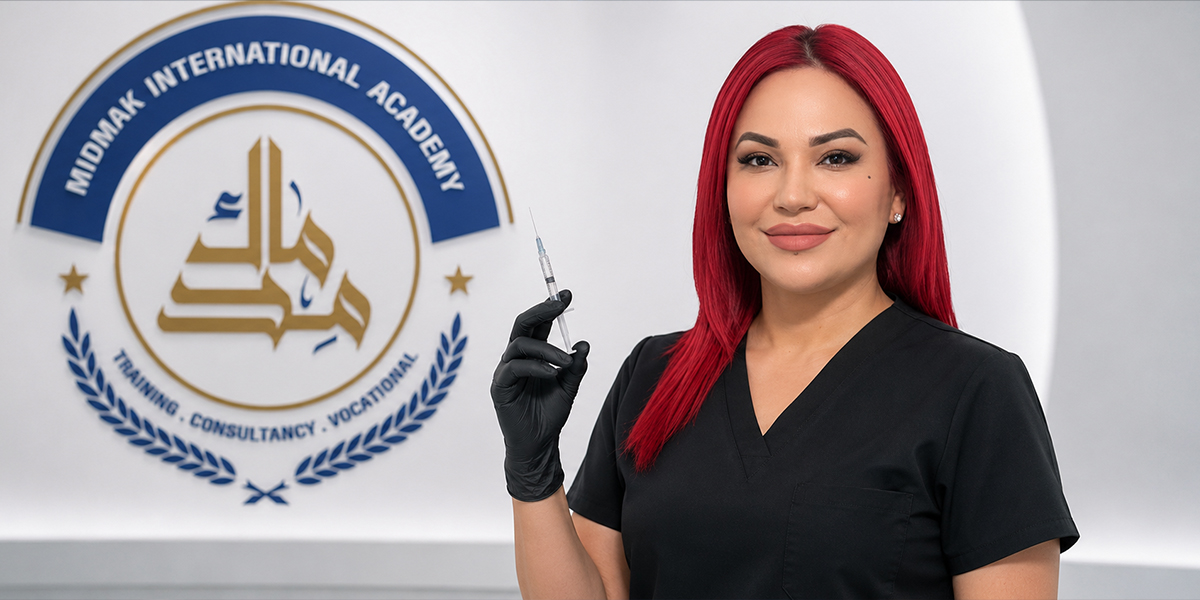
Specialist Ola Al-Junaidi: What Can We Learn from Non-Surgical Aesthetic Practice in Syria and Australia?
As part of Midmak International Academy’s “Experts and Trainers’ Insights” series, Specialist and Trainer Ola Al-Junaidi, based and professionally practicing in Australia, shares her perspective on the differences between non-surgical aesthetic practice in Australia and Syria, drawing on her professional experience in the Australian environment and her engagement with practitioners and trainees in the Arab region.
Al-Junaidi believes that comparing the two experiences should not be framed around the question “Which experience is better?”, but rather around a more meaningful question: “What can we learn from different professional experiences?”
Non-surgical aesthetics is no longer simply a collection of techniques and procedures. It has evolved into a professional field where science meets skill, assessment meets communication, and aesthetic outcomes are closely connected to patient safety and professional responsibility.
She explains that the Australian professional environment places significant emphasis on the framework surrounding practice, beginning with patient suitability assessment and understanding the patient’s needs and expectations, followed by clear communication and informed consent, and extending to documentation, follow-up, and adherence to professional scope and standards.
In Syria, she notes the presence of highly capable professionals and experienced practitioners, together with growing demand for non-surgical aesthetic techniques, alongside the unique characteristics of the local market and the needs of both practitioners and patients. This makes continuous professional development and knowledge exchange important factors in advancing practice.
Al-Junaidi emphasizes that the real value does not lie in replicating an Australian or any other international model, but in learning from global professional experience and adapting best practices to the local context, while maintaining the scientific, ethical, and professional foundations of practice.
She also highlights that one of the most important differences worth examining is the concept of professional practice itself. A distinguished practitioner is not measured solely by their ability to perform a procedure, but by their ability to assess the case, understand the patient’s needs, manage expectations, and recognize when a procedure is appropriate—and when choosing not to perform it may be the more professional decision.
Al-Junaidi further stresses that advancing the field requires investment in competency development, not merely technical knowledge transfer. Effective training should provide practitioners with the knowledge to understand the rationale behind a procedure, the practical skills to perform it, and the professional judgment needed to make the right decisions.
From this perspective, she believes that building a network of experts and trainers across different countries represents a genuine opportunity to create a professional bridge for knowledge exchange, ensuring that international experiences can be connected with the realities of practitioners in the Arab region and transformed into knowledge that can be shared and developed.
This perspective reflects Midmak International Academy’s commitment to building an international network of experts and trainers, connecting professional competencies across different environments, and drawing on diverse experiences to develop its programs and professional pathways.
Professional development does not come from a single experience, but from the ability to learn from different experiences and transform them into better knowledge and practice.
Experts and Trainers’ Insights | Midmak International Academy